
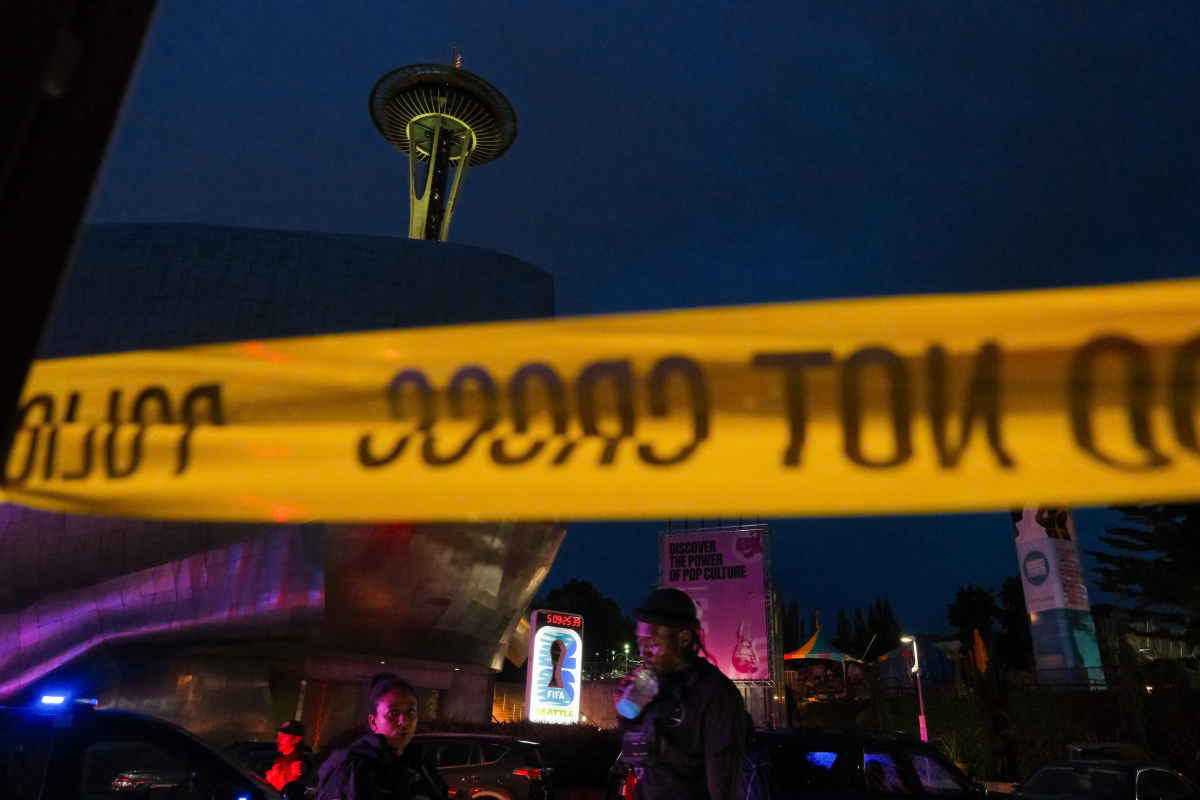
A Seattle cop killed a grad student in a crosswalk and his union’s vice president laughed about it. Another answered a sting ad hinting at an underage girl. A sergeant with a long record of violence beat a disabled veteran at a bus stop and got a one-day suspension. Meanwhile, nearly 400 Seattle officers made over $200,000 in 2024 while the workers around them struggle to make rent. This is what “public safety” looks like in Seattle and the departments around it.

Seattle pays its police some of the highest wages in the country, and in return it has gotten a department where officers kill pedestrians at triple the speed limit, laugh about it on camera, beat people in crisis, and get caught texting decoys posing as underage sex workers. The badge says “public safety.” The record says something else.
This isn’t about one bad apple. It’s about a pattern: the same names showing up in lawsuit after lawsuit, discipline that shrinks every time it moves up the chain of command, a police union that treats lawful left-wing groups as the enemy, and a city that keeps writing bigger checks while the people those checks are supposed to protect scrape together rent. Here is what the public record shows.
Jaahnavi Kandula: killed in a crosswalk, laughed about on camera
On January 23, 2023, Jaahnavi Kandula, a 23-year-old graduate student at Northeastern University’s Seattle campus, was walking through a marked crosswalk at Dexter Avenue North and Thomas Street. SPD Officer Kevin Dave, driving to an overdose call, was doing as much as 74 mph in a 25 mph zone and still hit her at about 63 mph. She had the right of way. He had his lights on but only chirped his siren instead of running it continuously. The impact threw her roughly 100 feet.
Then came the part that made international headlines. Daniel Auderer, an SPD officer and vice president of the Seattle Police Officers Guild (SPOG), went to the scene and called guild president Mike Solan. His body camera caught him laughing and saying her life had “limited value” and that the city should “just write a cheque.” He even got her age wrong.
What accountability looked like:
- No criminal charges. In February 2024, King County Prosecutor Leesa Manion said there was not enough evidence to prove a crime beyond a reasonable doubt.
- A $5,000 traffic ticket. The city attorney issued Dave a $5,000 traffic infraction. He missed the payment deadline and the ticket went into default.
- Firings, eventually. Auderer was fired in July 2024. Dave wasn’t fired until January 2025, nearly two years after he killed her.
- The taxpayers paid. In February 2026, the city settled with Kandula’s family for $29 million. Auderer told his union boss the city should write a check. In the end, the public wrote it for them.
Auderer wasn’t an unknown quantity when this happened. The police watchdog DivestSPD had already documented 18 prior OPA investigations into him. His own union elected him its vice president anyway.

The SPOG vice president’s rant about the DSA and “antifa”
Before Auderer laughed about Kandula, he had already shown the public how he sees political opponents. On May 29, 2021, the anniversary of George Floyd’s murder, he made a routine DUI arrest. In the police report, he inserted an unprompted tangent about spending the first half of his shift managing “the weekly DSA, Antifa, and various other groups” that he said the city had let flourish by refusing to use government authority to keep order.
The Democratic Socialists of America is a lawful political organization. Its members vote, run for office, and hold permits for marches. An officer writing it into a DUI report alongside “political violence” tells you who he thinks the threat is.
The Office of Police Accountability (OPA) sustained an unprofessionalism finding, warning that his commentary could be read as endorsing a violent crackdown on free political expression. His punishment was a reprimand. It was his third sustained OPA finding since 2016. His record before that included being one of roughly a dozen officers involved in the 2010 beating of Brian Torgerson, a mentally ill man left with permanent brain damage, which cost the city $1.75 million.
This attitude runs straight to the top of the union. In January 2021, guild president Mike Solan blamed Black Lives Matter for the Capitol riot, and eight of nine councilmembers called for his resignation. In September 2025, he cheered President Trump’s move to designate antifa a terrorist organization, calling it a big win for public safety. These are the people negotiating Seattle’s police contract and speaking for its officers.
Officer Cleades Robinson and the underage sex-work sting
In December 2021, the King County Sheriff’s Office ran an undercover human-trafficking operation at a Radisson in SeaTac, posting bait ads that hinted at youth. One of the men who answered was Seattle Police Officer Cleades Robinson.
According to the OPA report, Robinson asked for a “quick visit” and negotiated a price. When the detective signaled she was underage, Robinson texted, “I don’t think I can mess with under 18,” and then later asked where they were. Phone location data put him parked a block from the hotel on both days of the sting. Investigators also found records of him contacting other escort services.
King County never charged him; prosecutors didn’t think they could make a felony case. OPA, though, found more than enough evidence that he had committed two gross misdemeanors, patronizing a prostitute and communicating with a minor for immoral purposes. It called his claim that he was “just curious” preposterous and recommended firing him.
He was never fired. Robinson resigned before discipline was handed down, then surrendered his state certification in January 2024 without ever facing a criminal court. Ask yourself whether a civilian caught in the same sting would have walked away with nothing but a resignation letter.

Sergeant Nathan Patterson and Officer Cody Alidon: a beating at a bus shelter
On May 31, 2024, a bus passenger filmed two SPD officers hitting a man over and over at a bus shelter. The Stranger identified them as Sergeant Nathan Patterson and Officer Cody Alidon. They had been called about a man accused of assaulting someone with a walking stick and trying to set a house on fire.
The OPA’s own case summary tells you how it went. The man came down to the sidewalk when asked. He told officers he was a disabled veteran, said repeatedly that he could walk on his own, and offered to cooperate if they stopped being forceful. The sergeant, baton drawn the whole time, told him to “sit your ass down.” When officers announced handcuffs, the man pulled away and swung at the sergeant, and the fight was on: a head hold, punches, a knee strike, and a long series of baton strikes. Afterward the man said he had severe PTSD and had grabbed an officer’s leg because he was looking for comfort. He left with a cut across the bridge of his nose and swelling on his face and side.
OPA concluded the sergeant failed to de-escalate and kept hitting the man with his baton after he’d been knocked over and no longer posed the same threat, and it rejected the sergeant’s explanation for those extra strikes as guesswork that didn’t hold together. It cleared the other officer’s force as lawful and gave him a training referral.
Then watch what happened to the discipline:
| Stage | Discipline for the sergeant |
|---|---|
| Discipline committee proposed | 10 to 15 days’ suspension and possible demotion |
| Chief actually imposed | 1 day’s suspension, a transfer, and retraining |
Patterson’s record made this predictable. The DOJ used a 2010 Patterson arrest, in which four officers beat and tased a sleeping 5’3″, 130-pound man, as an example of SPD’s excessive force; the city paid about $90,000. A 2011 party raid in which officers kept hitting a handcuffed man cost $195,000. In a 2012 video, Patterson boasted about breaking a nightstick, and when asked what he broke it on, he answered, “One of you.” In 2020, OPA found he used disproportionate force throwing up to eight punches at a protester. He made about $155,000 in 2023, and the city owed him roughly $60,000 more in back pay under the new contract.
Officer Marlon Williams-Booth: accused of trapping and assaulting his wife
Content note: domestic violence. The account below comes from a Thurston County police report obtained by DivestSPD. These are allegations; no conviction has been reported.
On May 28, 2026, Thurston County deputies were sent to the Yelm home of SPD Officer Marlon Williams-Booth. His wife had told him she was leaving. According to her statement, he blocked the only exit from the home office, pinned her against the wall, pulled her pistol from its holster, grabbed her by the hair, and took her to the ground with the gun’s frame pressed against her throat. She escaped by kicking him off and climbing out a window, leaving her gun and purse behind.
A county detective found the evidence consistent with her report.
Content note: domestic violence. The account below comes from a Thurston County police report obtained by DivestSPD. These are allegations; no conviction has been reported. Statement with her account: clumps of hair where the struggle happened, a ripped purse strap, and injuries to her lip and nose. Deputies developed probable cause to arrest him for misdemeanor domestic violence assault and unlawful imprisonment, and SPD command went along to take him into custody.
On the way to jail, he described himself as one of the “elite heroes of downtown Seattle” and claimed to have killed people. SPD’s own records show he has never fired his weapon on duty. His base pay is $146,557 a year before overtime.
He is not an outlier. The same reporting lists other recent SPD domestic violence cases, and the state’s 2024 decertification records include an SPD officer fired for assaulting her domestic partner while drunk at a coworker’s party and another fired after a public fight with his spouse and a brawl with the officer who responded. These are the people we send when someone calls 911 about abuse at home.

It isn’t just Seattle
The same patterns show up in departments all around Puget Sound. A sample from court records, OPA files, and the state’s own decertification reports:
| When | Officer and agency | What happened | Outcome |
|---|---|---|---|
| 2019 (sentenced Jan 2025) | Jeffrey Nelson, Auburn PD | Shot Jesse Sarey, a 26-year-old homeless man in crisis, point-blank in the stomach during a disorderly-conduct arrest. Sarey was the third person Nelson killed on the job. | Convicted of murder; sentenced to 16 years, 8 months. Auburn paid $4M to Sarey’s family and nearly $2M more over Nelson’s conduct. |
| 2019 (inquest July 2026) | Ryan Beecroft and Christopher Myers, SPD | Shot and killed Ryan Smith in Queen Anne. Myers has shot three people in his career. | Inquest jury cleared both; city paid $975,000 to settle the wrongful-death suit. |
| Decertified 2024 | Marcus Martin, SPD | Hit a car with his patrol vehicle, then responded to the hit-and-run call himself, turned off his body camera, and tried to talk the owner out of reporting it. | Fired; certification revoked. |
| Decertified 2024 | Brandon Gandy, SPD | Internal investigation found he associated with drug traffickers and was likely involved in trafficking. | Resigned before termination. |
| Decertified 2024 | Jesse Jahner, Tacoma PD | Called to help a child in a mental health crisis, he and his partner urged the guardian to beat the child with a belt while he held the child down. | Convicted of official misconduct; fired. |
| Decertified 2024 | Michael Morfoot, Kent PD | Told apartment staff that street justice beats the real kind; long disciplinary history. | Fired. |
| Decertified 2024 | Quan Nguyen, Renton PD | Stole luggage at Sea-Tac Airport off duty, then lied about it to Port police and internal investigators. | Resigned in lieu of termination. |
| 2020 (verdict Dec 2023) | Three Tacoma PD officers | Manuel Ellis, 33, died after being restrained by Tacoma police. | All three acquitted of murder and manslaughter. |
The paycheck: $200,000 cops in a city where workers can’t make rent
Nearly 400 Seattle police officers cleared $200,000 in 2024, and 76 cleared $300,000, according to DivestSPD’s analysis of city payroll. The top earner, a sergeant previously caught asleep in her cruiser parked in a Third Avenue bus lane, took home $509,281.
| Measure | Figure |
|---|---|
| SPD employees paid $200,000+ in 2024 | Nearly 400 |
| SPD employees paid $300,000+ in 2024 | 76 |
| Highest-paid SPD employee, 2024 | $509,281 |
| Retroactive raise in the 2024 police contract | 23% (PubliCola) |
| Starting salary for a new SPD officer, 2026 | About $118,000; only San Francisco and San Jose pay more among the 20 largest U.S. cities (Axios) |
| Signing bonus for officers hired from other departments | Up to $50,000 (KATU) |
| Overpayments SPD sent officers by mistake | More than $13 million (PubliCola) |
Much of that money is overtime. SPD’s overtime rose to around 500,000 hours in 2024, and by late 2025 the department had blown through its overtime budget so badly that it stopped funding overtime for burglary and theft investigations. Officers got the money; victims of property crime got told to wait.
The city has also floated perks for police that most of its workers can only dream of. In March 2024, then-Council President Sara Nelson pitched subsidized housing for police officers at the same moment affordable housing funding was on the chopping block. Take-home patrol cars and child care were also on the list. That fall, the council passed a budget that cut affordable housing and social services to boost police spending by 16 percent.
Compare that to everyone else. In 2024, as police locked in raises totaling 23 percent over three years, about 8,000 other unionized city employees were getting a 9.7 percent cost-of-living adjustment. Seattle’s median rent is about $2,083 a month, and nearly half of Seattle-area renters are cost-burdened, spending more than 30 percent of their income on housing. The librarians, parks workers, and utility crews who keep this city running aren’t pulling $300,000 in overtime. Many of them can’t afford to live in it.
Public safety for whom?
The police budget is sold to us as public safety. But look at who has actually been made unsafe in these stories: a graduate student in a crosswalk, a disabled veteran at a bus stop, a woman trying to leave her husband, the very kids a vice sting is meant to protect. In every case, the danger wore a badge.
And when officers do harm, the system protects them, not us. Prosecutors decline charges. Recommended suspensions of two weeks become one day. Officers resign before they can be fired, and the city settles the lawsuit with our money. The union that defends them in contract talks spends its public voice attacking protesters, socialists, and “antifa” rather than the misconduct in its own ranks.
Seattle residents have noticed. In Seattle University’s 2025 Public Safety Survey, the citywide police legitimacy score, which measures trust and confidence in the police, was 38.7 out of 100, and it declined again after a brief uptick in 2024. That’s not a city that feels protected. That’s a city where many people, at protests, in crisis, or living outside, have learned that calling the police can make a bad situation worse.
Public safety should mean the public is safe, including from the people we arm and pay to protect it. Until officers who kill, beat, and abuse face the same consequences as anyone else, and until the money follows the needs of the people instead of the overtime sheets of the department, Seattle’s police will keep being something many residents fear rather than trust.
Sources
- Officer who fatally struck Jaahnavi Kandula fired (KOMO/Sinclair)
- Group rallies calling for justice for Jaahnavi Kandula (KOMO/Sinclair)
- King County prosecutors decline to charge SPD officer (The Stranger)
- Seattle to pay $29M to Kandula family (The News Minute)
- Seattle cop who killed Andhra student fired (The News Minute)
- SPOG vice president’s rant about DSA and antifa (DivestSPD)
- Solan defends Capitol coup (The Urbanist)
- SPOG head supports antifa terrorist designation (The Center Square)
- SPD officer solicited sex from detective posing as underage sex worker (DivestSPD)
- Bad Apples: 2023 (The Stranger)
- WSCJTC 2024 Certification Action Summaries (Washington State Criminal Justice Training Commission)
- SPD sergeant caught on video repeatedly hitting suspect (The Stranger)
- OPA Closed Case Summary 2024OPA-0238 (Seattle Office of Police Accountability)
- Seattle cop arrested for assaulting, imprisoning his wife (DivestSPD)
- The Divest Digest: July 29, 2026 (DivestSPD)
- Ex-Auburn cop sentenced for murder of Jesse Sarey (KOMO)
- Auburn cop first sentenced under accountability law (PubliCola)
- Nearly 400 Seattle cops made over $200k in 2024 (DivestSPD)
- Tentative police contract includes 23 percent retroactive raise (PubliCola)
- Seattle police starting salary tops most major U.S. cities (Axios Seattle)
- Council approves $50,000 hiring bonuses (KOMO/KATU)
- SPD overpaid officers by $13 million (PubliCola)
- This Week on PubliCola: Dec. 6, 2025 (PubliCola)
- Seattle Council wants to subsidize cop housing (The Urbanist)
- Council passes budget swiping affordable housing funds to boost SPD (The Urbanist)
- Cost of living in Seattle, 2026 (Apartment List)
- Renter cost burden in the Seattle area (Seattle Times via Tribune)
- 2025 Seattle Public Safety Survey results (Westside Seattle)
- Citywide survey results (West Seattle Blog)
- Seattle police hiring surges sixfold in 2025 (Axios Seattle)
- Poll shows high support for CCTV and patrols (FOX 13)